We are the bookend sisters. I am Susan Lee Kerr, the eldest and the wordy one. She is Meg Kaczyk, the youngest (of 6 of us siblings) and the arty one. We each made our living by our art/craft, and now continue to practice. So of course I turned to her for the cover of my new haiku collection, Learning to Leave. As I did for the first one, The Walk Home. This time there’s more to the story.
Meg offered me four paintings she thought could work. Elegy, with its misted blues, greens and whites, its dashes of red, spoke to me right away. It looked like they might be prayer flags. That incidentally resonates with meaning between us because Meg was widowed two years ago, tall banner flags part of her Joe’s burial ceremony. Bookend sisters again, on journeys of care with our husbands.
But there’s more! This is a story with layers. Meg’s painting was based on her response to a poem. She says:
You can see how I work… I wrote my own notes on my response to the poem. The watercolor snippet was a piece from a sketchbook (the whole sketch was of a boat at a dock with festive flags). That system was how I arrived at abstraction.
And there, do you see it? The poem itself is in haiku form! It’s by Linda M. Robertson. For ease of reading I repeat it here:
Searching for you,
       the devoted sun comes first
                 to your bedroom window.
It is titled Elegy for Evan. Evan was Linda’s son, who died in a mountain climbing accident, Meg worked with Linda on a whole exhibition a few years ago. Meg has now written, and painted, her own book, uniquely beautiful and sensitive, Notes from Next to the Bed: a caregiving love story in words and pictures. For more on Meg, and Linda too, see Meg’s site here.
So, story within story within story, grief within grief within grief. As I say on the back cover of Learning to Leave, haiku (and here I add art-making) is a way. A way of life, a way through life. The 65 haiku in the collection catch living moments of the everyday over the last five years. For a free sampling watch this space, and jump here on this site. Or jump here to buy your very own copy, available only through me at present.
Learning to Leave is published, and haiku is a way — a way of life, a way through life. Restless winds, a vixen’s call, emptying packing boxes, kicking through a mood, a fingernail of moon…
The story behind the book? Life changing accident — we all know that phrase. In 2019 my husband had a simple fall which resulted in paralysis from spinal cord injury. Change indeed for us both, a forceful entry into a new world of disability, medics and carers… of uprooting from a home of forty years and ultimately reweaving the pieces of life.
Susan Lee Kerr’s second haiku collection, Learning to Leave, gathers sixty-five luminous moments — everyday fragments reimagined, life’s challenges met, where haiku and art quietly mend the heart’s tapestry, one healing breath at a time.
— Iliyana Stoyanova, President, British Haiku Society
Click here books by SLK for more details on the book and on me. To purchase, please request on the comments option on this site, or Instagram @slkerrcreative and we’ll take it from there.
Imagine the thrill of having an outstanding USA writer-blogger choose to feature your book. So there’s me, living that for real. Thank you Charlotte Digregorio, been following your Daily Haiku for years, a daily gift of creme de la creme. And for your comments: ‘beautiful striking imagery… fresh expression… simplicity, yet elegance.’ See more here, along with double-filtered haiku.
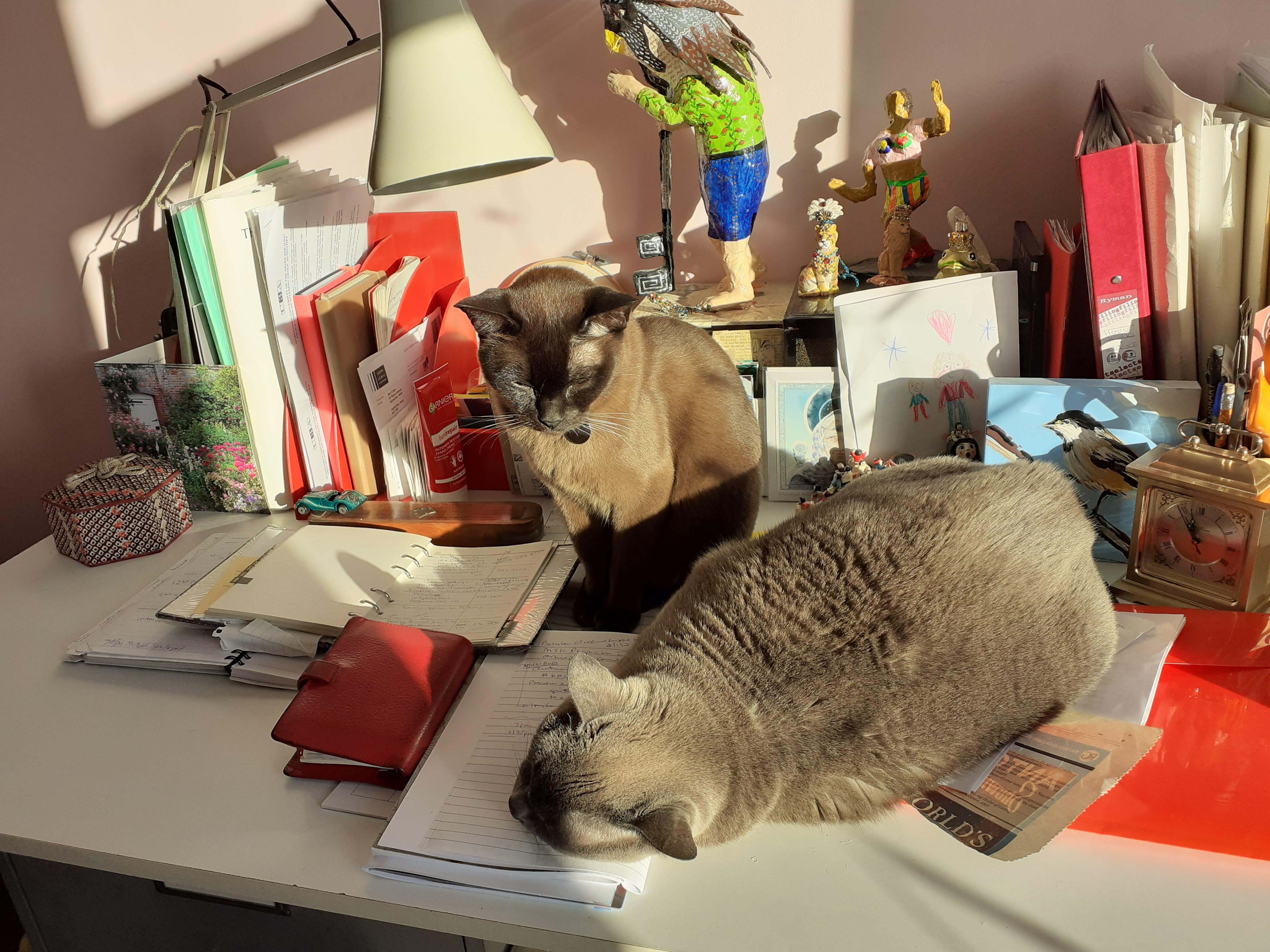
Hello! Long time away from my desk. But isn’t moving house a perfect excuse? Six months later, still settling into my new environment. At this point I’m calling it a Burmese Writer’s Block. Meanwhile Great grandfather Ephraim Epstein is still smiling down on me (I hope!). And Intersaga, the literary agency, has chosen to Instagram a haiku per month from my collection The Walk Home. Thank you Intersaga!!
There it is above, my new sleek shaped-up office book shelves — my insides feel all glad seeing books and binders-ful of notes stand up straight. That row of neat white on the left is haiku journals (and another half-shelf below). When feeling at a loss, I just pluck one at random and browse: space, uplift, senses, escape. For the season now between winter and springclick here for a new haiku on the ‘so still’ page.
Such a weeding out of books and papers! Honestly, several trees’ worth of weight went out to the paper recycle. And boxes of books await trips to the charity bookshop. If anyone reading here would like giveaways of How to Write books collected over the years to aid teaching creative writing AND my own creative writing, contact me via Comments below. Of course I’ve kept my favs, but I’d love the others to find homes among those who want to write (for the price of postage).
The project also provided a review of my last ten working years, both sobering (how time flies!) and heartening (I’ve done more than I give myself credit for). And look, there’s even shelf-space for… more books.
Oooo, notice the pink. I have discovered the text colour facility on WordPress. Cue to reveal that the repainted walls of my renewed office are very pale pink. Now: on with the self-publishing adventure, a new ISBN on an IngramSpark p-o-d. If that’s gobbledygook to you it shows me that I have learned a lot in the last year…
Really I should say clearing as writing. Or even better, clearing as pre-writing. It’s not easy, coming off the five or even ten years of writing the novel of my great grandfather’s life. It’s like he’s been riding me, on my back all that time. And now — whooph! Loose ends. Shouldn’t I be plunging into the next idea? Turns out, no. Well, yes-and-no. Love the idea, have done bits of writing, some research, but I feel, I KNOW it is too soon. I find I am at this stage, described by Eric Maisel,
When you choose an idea to work on, what is appropriate to know is that you largely do not know what is about to happen… the artist who is more interested in creating deeply than in ridding herself of anxiety will refuse to know too soon. She will remain with doubts, worries, questions, and the burning desire to realize herself… This is the chaos working, the necessary chaos…
I found that quote in the Mslexia magazine diary of 2006 (how loyal I am, a subscriber from the start! And the diary is a great aid, every year.)
Instead of writing I am clearing my bookshelves. It is a psychological and mythological truth that sorting is a psychic task. So, my physical urge and my inner state are definitely together in this. Out they go, years and years of teaching materials, winnowing them down to one or two… maybe three binders. Many of the how-to-write books that helped me write and teach, clear out! Clippings and Good Ideas (from ten years ago?!), gone! Goodness knows the quantity of trees the paper represents. All I do know is that my heart is delighted, satisfied, with the empty plastic pages and the binders, and it loves sticking blank labels over the written ones. What does it want? What do I want? Space.
Time for a tiny bit of the constructive to balance this: I’ve added an autumn haiku to so still, my haiku page.
So, nearly the length of a pregnancy since I started this site and began to figure out WordPress. In the meanwhile I have finished, formatted, self-published and launched my novel under the book-and-blog guidance of the wonderful Catherine Ryan Howard. And I’ve wordpressed and facebooked my protagonist (and great grandfather) as a being in his own right. Now it’s time to turn this blog into something more useful, especially useful for writers. Yes I mean authors, creators.
So I’ve moved the moments of peace to their own pages — haiku to ‘so still’ and photographs to ‘green slash’. I couldn’t bear to give up the gorgeous Turkish twilight, the allium seedhead and my own-grown roses (called Birthday Girl) which I’d had as headers, so I moved them to ‘natura naturans’ in the green slash department. Read the haiku and you’ll grasp that title. I will add haiku and photos season by season.
Jude got attention from an editor for her historical novel, which she had told in two voices, from two time points. Great going to get feedback from an editor! But ed suggested a rewrite, into a straight chronological narrative. Should she do it?
My experience: after trying for years to find the voice for my historical-novel-based-on-a-true-story in various creative ways, I finally bit the bullet. Decided to stop being clever and just Tell the Story, chronologically. Writing flowed more easily and naturally. I tried to make the most of the natural ups and downs as events rolled on.
If you’re in how-to-tell-it anguish, don’t be afraid to try the straightforward way… but changing your head around after the long slog of writing can be painful. On the other hand, should this anguished writer try another editor?


 Be here now